
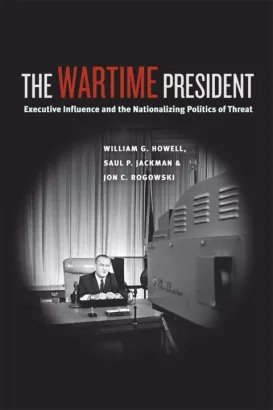
Wartime President
Executive Influence and the Nationalizing Politics of Threat
Bemærk venligst, at den normale 14 dages fortrydelsesret ophører ved modtagelse af adgang til e-bogen.
Produkt beskrivelse
"e;It is the nature of war to increase the executive at the expense of the legislative authority,"e; wrote Alexander Hamilton in the Federalist Papers. The balance of power between Congress and the president has been a powerful thread throughout American political thought since the time of the Founding Fathers. And yet, for all that has been written on the topic, we still lack a solid empirical or theoretical justification for Hamilton's proposition. For the first time, William G. Howell, Saul P. Jackman, and Jon C. Rogowski systematically analyze the question. Congress, they show, is more likely to defer to the president's policy preferences when political debates center on national rather than local considerations. Thus, World War II and the post-9/11 wars in Afghanistan and Iraq significantly augmented presidential power, allowing the president to enact foreign and domestic policies that would have been unattainable in times of peace. But, contrary to popular belief, there are also times when war has little effect on a president's influence in Congress. The Vietnam and Gulf Wars, for instance, did not nationalize our politics nearly so much, and presidential influence expanded only moderately. Built on groundbreaking research, The Wartime President offers one of the most significant works ever written on the wartime powers presidents wield at home.
Oplysninger om tilgængelighed
Vælg variant af e-bog i højre side, for at se tilgængelighedsoplysninger.
Detaljer
- ISBN13 9780226048420
- Udgivet 2013
- Forlag University Of Chicago Press
- Format Elektronisk medie
- Udgave 1
- Sprog Engelsk