
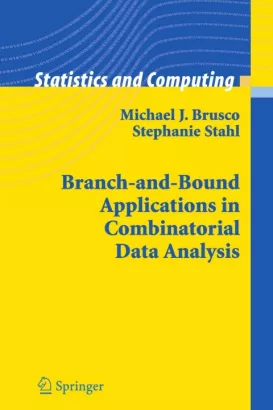
Branch-and-Bound Applications in Combinatorial Data Analysis
Bemærk venligst, at den normale 14 dages fortrydelsesret ophører ved modtagelse af adgang til e-bogen.
Produkt beskrivelse
This monograph focuses on the application of the solution strategy known as branch-and-bound to problems of combinatorial data analysis. Combinatorial data analysis problems typically require either the sel- tion of a subset of objects from a larger (master) set, the grouping of a collection of objects into mutually exclusive and exhaustive subsets, or the sequencing of objects. To obtain verifiably optimal solutions for this class of problems, we must evaluate (either explicitly or implicitly) all feasible solutions. Unfortunately, the number of feasible solutions for problems of combinatorial data analysis grows exponentially with pr- lem size. For this reason, the explicit enumeration and evaluation of all solutions is computationally infeasible for all but the smallest problems. The branch-and-bound solution method is one type of partial enume- tion solution strategy that enables some combinatorial data analysis pr- lems to be solved optimally without explicitly enumerating all feasible solutions. To understand the operation of a branch-and-bound algorithm, we d- tinguish complete solutions from partial solutions. A complete solution is one for which a feasible solution to the optimization problem has been produced (e. g. , all objects are assigned to a group, or all objects are - signed a sequence position). A partial solution is an incomplete solution (e. g. , some objects are not assigned to a group, or some objects are not assigned a sequence position).
Oplysninger om tilgængelighed
Vælg variant af e-bog i højre side, for at se tilgængelighedsoplysninger.
Detaljer
- ISBN13 9780387288109
- Udgivet 2005
- Forlag Springer
- Format Elektronisk medie
- Sprog Engelsk