
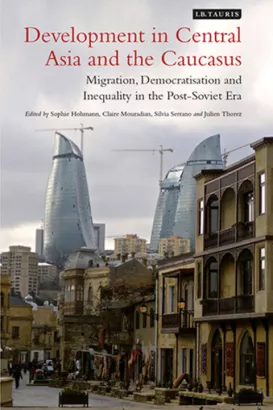
Development in Central Asia and the Caucasus
Migration, Democratisation and Inequality in the Post-Soviet Era
Bemærk venligst, at den normale 14 dages fortrydelsesret ophører ved modtagelse af adgang til e-bogen.
Produkt beskrivelse
After the final collapse of the Soviet Union, the so-called 'last empire', in 1991, the countries of Central Asia - Kazakhstan, Kyrgyzstan, Uzbekistan, Tajikistan, Turkmenistan - and of the Caucasus - Armenia, Azerbaijan, Georgia - became independent nations. These countries, previously production centres under the socialist planning system of the Soviet Union, have made enormous economic adjustments in order to develop - or attempt to develop - along capitalist lines. As this study will show, however, inequality in Central Asia and the Caucasus is widening, as the Soviet systems of healthcare and state provisions disappear. Rejecting the Cold War-era East/West paradigm often used to analyse the development of these nations, this study analyses development along the North-South lines which characterise the migration patterns and poverty levels of much of the rest of the developed world. This opens up new avenues of research, and helps us understand why it is, for instance, that this region is better characterised as a 'new South' - as skilled workers flood out of the territories and into Russia and Western Europe.Development in Central Asia and the Caucasus draws together detailed analyses of the development of migration economics as the region's oil wealth further enhances its strategic and economic importance to Russia, the US, the Middle East and to the EU.
Oplysninger om tilgængelighed
Vælg variant af e-bog i højre side, for at se tilgængelighedsoplysninger.
Detaljer
- ISBN13 9780857737342
- Sider 416
- Udgivet 2014
- Forlag I.B. Tauris
- Format Elektronisk medie
- Udgave 1
- Sprog Engelsk